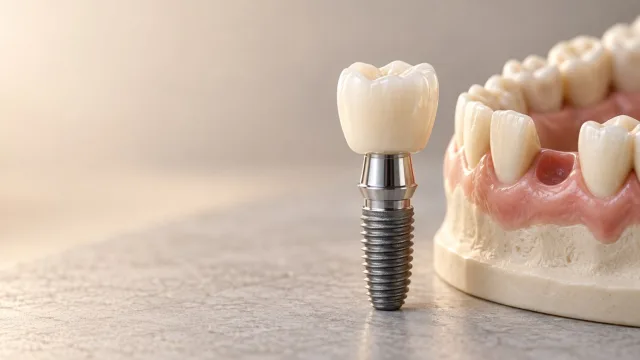
Pros and Cons of Dental Implants: Cost, Bone Health & Risks
Dental implants offer a stable, long-lasting tooth replacement but involve surgery, months of healing and higher upfront cost. This guide weighs pros, cons and risks and compares implants to bridges and dentures.


Dental implants are titanium posts that a surgeon places into the jawbone to replace a missing tooth root, topped with a crown that matches the natural teeth around it. They work well for patients with healthy gums and enough bone density, though healing can take months and the surgical procedure carries real risks. This guide weighs the advantages and disadvantages of dental implants against bridges and dentures so you can see where each option fits.
Overview of this article
- What exactly is a dental implant?
- What are the main advantages of dental implants?
- What are the disadvantages of dental implants?
- Does bone loss affect who can get an implant?
- What risks and complications come with implant surgery?
- How do implants compare to bridges and dentures?
- What does the implant procedure actually involve?
- What should you weigh before choosing implants over other options?
- Frequently Asked Questions
- Sources
What exactly is a dental implant?
A dental implant is a small titanium screw that replaces the root of a missing tooth. Once placed, the surrounding bone grows around the titanium in a process called osseointegration. An abutment connects the implant to a crown, bridge, or denture on top. Unlike a removable denture, a dental implant is fixed in place and does not shift when you chew.
The dental implant can replace one missing tooth or support a full arch restoration. For patients missing several teeth in a row, implants can anchor a fixed bridge instead of a removable one, which is covered in more detail in the comparison of a dental bridge against an implant-supported option.
What are the main advantages of dental implants?
The biggest advantage is that implants look and feel like natural teeth, both in appearance and in how they handle chewing. Patients report that speech and comfort improve compared to a loose denture, since the implant does not move during eating or talking.
- Implants help preserve the jawbone, because chewing pressure transfers through the titanium post the way it once did through a natural root.
- They keep adjacent teeth stable and healthy, since a bridge requires grinding down neighboring teeth for support but an implant does not touch them.
Dental implants offer a fixed restoration, which many patients prefer to the look of a removable denture. For patients weighing a full-mouth restoration, the All-on-4 dental implants concept uses four implants per arch to support a complete set of fixed teeth.
What are the disadvantages of dental implants?
The disadvantages of dental implants center on cost, time, and the surgical procedure itself. A single implant is generally more expensive than a bridge or a denture, and insurance coverage for implants is often limited. The dental implant cost depends on the number of implants, the need for bone grafting, and the type of restoration placed on top.
Treatment time is another drawback. From initial consultation to the final crown, the process can take several months because the jawbone needs time to heal around the titanium post before a permanent crown is attached. Patients who need bone grafting first face an even longer timeline. For patients comparing options, a tooth replacement guide lays out cost and durability differences between implants and bridges side by side.
Does bone loss affect who can get an implant?
Yes. An implant needs enough bone density in the jaw to hold the titanium post securely. Patients who have worn dentures for years, or who lost teeth long ago, often experience bone loss in the jaw because there is no tooth root left to stimulate the bone.
In these cases, a surgeon may recommend bone grafting before placement: a procedure that adds bone material to the jaw so it can support an implant later. Grafting adds healing time, sometimes several months, before the implant itself can be placed. Patients with gum disease that is not under control are not good candidates until the infection is treated.
What risks and complications come with implant surgery?
Dental implant surgery is a surgical procedure, and like any surgery it carries risk.
- Infection near the implant site, sometimes linked to poor oral hygiene after surgery.
- Nerve damage if an implant is placed too close to a nerve in the lower jaw.
- Implant failure, where osseointegration does not occur and the post has to be removed.
- Gum recession around the implant over the years, which can affect appearance.
Most patients heal without serious problems, but a consultation with an oral surgery specialist beforehand helps identify medical conditions, like uncontrolled diabetes or smoking habits, that raise the risk of complications.
How do implants compare to bridges and dentures?
Each tooth replacement option has a different balance of cost, durability, and care. The table below compares the three most common alternatives.
| Option | Fixed or removable | Effect on adjacent teeth |
|---|---|---|
| Dental implant | Fixed | None, stands independently |
| Dental bridge | Fixed | Requires grinding adjacent teeth for support |
| Denture (full or partial) | Removable | Partial dentures may clasp onto natural teeth |
A bridge is often faster and less expensive than an implant, but it depends on healthy adjacent teeth to anchor the restoration. A denture is the least invasive option and avoids surgery altogether, but it is removable and some patients find it less stable when chewing.
What does the implant procedure actually involve?
The process typically unfolds over several appointments rather than in a single visit.
- Initial consultation and imaging to assess bone density and plan implant placement.
- Bone grafting, if needed, followed by a healing period of several months.
- Surgical placement of the titanium implant into the jawbone.
- A healing period while the implant fuses with the surrounding bone through osseointegration.
- Attachment of the abutment, the connector piece between implant and crown.
- Placement of the final crown, bridge, or denture on top of the abutment.
Because the jawbone needs time to heal, the full treatment can take anywhere from a few months to close to a year depending on whether grafting is required.
What should you weigh before choosing implants over other options?
Cost, time, and overall health are the three factors that usually decide the choice. Patients considering implants should discuss their medical history, bone density, and lifestyle, including smoking, with a specialist before committing to the surgical procedure.
For some patients, a bridge or denture remains the more practical replacement option, particularly when bone grafting would add significant time and cost.
Frequently Asked Questions
Who is a good (and poor) candidate?
A good candidate has adequate bone density, good oral hygiene habits, and no untreated gum disease. A poor candidate might have severe bone loss without grafting, uncontrolled diabetes, or heavy smoking habits that raise the risk of implant failure. Age alone isn't usually a barrier.
How do you care for dental implants after placement?
Implants need the same oral hygiene routine as natural teeth: brushing, flossing, and regular dental visits. Because an implant can't develop a cavity, the main long-term risk is an infection of the surrounding gum tissue, sometimes called peri-implantitis, which can threaten the bone supporting the implant if left untreated.
Regular check-ups let the treating professional catch early signs of gum inflammation before they become a bigger problem. Patients who smoke or have a history of gum disease should pay particular attention to this follow-up care, since their risk of complications is higher.
Sources
Dental Implants: What You Should Know — U.S. Food and Drug Administration
Implants — American Dental Association (MouthHealthy)
Dental Implant Procedures — American Academy of Periodontology
Single Tooth Dental Implants — American Academy of Periodontology
Dental Implants – Information for patients (LN001941) — Leeds Teaching Hospitals NHS Trust
Dental implants – Overview — Guy's and St Thomas' NHS Foundation Trust
Systematic Review and Meta-Analysis on Incidence of Altered Sensation of Mandibular Implant Surgery — PLOS One
Effectiveness of implant therapy analyzed in a Swedish population: early and late implant loss — Journal of Dental Research (via PMC)