
Losing a tooth forces a decision most people never expected to make: repair the gap with a fixed bridge anchored to neighboring teeth, or place a dental implant that stands on its own in the jawbone. Both are established forms of tooth replacement, and both can look and function like natural teeth once the work is finished. The right choice depends on your jawbone, your budget, your adjacent teeth, and how much time you're willing to spend on treatment. This guide walks through the practical differences so you can talk to an implantologist with the right questions already in hand.

Overview of this article
Dental Implant vs Dental Bridge: What's the Difference?
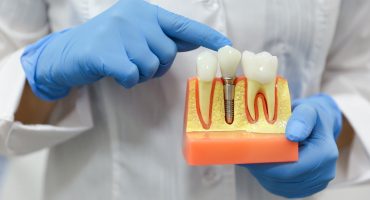
A dental implant is a titanium post surgically placed directly into the jawbone. Over several months the bone grows around the post in a process called osseointegration, after which an abutment and a crown are attached on top. Nothing is anchored to the neighboring teeth — the implant carries its own load, tooth root and all.
A dental bridge takes a different route. It uses two crowns, placed on the abutment teeth on either side of the gap, to support a false tooth suspended between them. The natural teeth do the structural work; the bridge simply rides on top of them. This is the core difference between the two options, and it shapes almost everything else in this comparison — cost, durability, and what happens to the surrounding teeth over time.
How Do Dental Implants and Dental Bridges Work?
The implant process usually starts with an evaluation of bone volume. If the jawbone has thinned from bone loss, a bone grafting procedure may be needed first to build enough structure to support the post. Once there's enough bone, the surgical placement itself is a same-day procedure, but healing — the osseointegration phase — typically takes a few months before the permanent crown goes on.
A dental bridge moves faster. The dentist or implantologist shaves down the two abutment teeth to receive crowns, takes an impression, and fits a temporary bridge while the permanent one is made — usually within a couple of weeks. No surgery, no waiting for bone to heal. That speed is the main reason bridges still get recommended even though implants generally last longer.
Pros and Cons of Dental Implants
Pros:
- Implants preserve the jawbone by stimulating it the way a natural tooth root once did, which helps prevent the bone loss that follows tooth loss.
- They don't rely on adjacent teeth, so healthy teeth next to the gap stay untouched.
Cons:
- The procedure is surgical and requires enough jawbone; some patients need bone grafting first, which adds months to treatment.
- Healing and osseointegration take time — patients waiting for a single missing tooth to be restored may go through several months before the final crown is placed.
- Upfront costs are usually higher than a bridge, and insurance coverage for implants varies more than for other prosthetics.
Pros and Cons of Dental Bridges
Pros:
- No surgery, which means a shorter timeline and less recovery.
- Dental bridges are typically more affordable upfront and are more likely to receive insurance coverage.
- A well-made bridge restores chewing function and appearance quickly.
Cons:
- The abutment teeth must be ground down to hold crowns, which is permanent and can leave those teeth at higher risk for decay if hygiene slips.
- A bridge does nothing for the jawbone underneath the gap, so bone loss can continue in that spot over the years.
One exception worth knowing: an implant-supported bridge rests on implants rather than natural teeth. This type of bridge must wait for the implants underneath to fully integrate with the jawbone before the bridge itself is attached — a hybrid that borrows the durability of implants without placing one post per missing tooth.
Cost Comparison: Dental Implants vs Bridges
A straight cost comparison without context is misleading, because the price of either option depends on how many teeth are missing, whether bone grafting is required, and the materials used for the crown. A single implant plus crown generally carries a higher upfront cost than a single bridge covering one gap; a detailed dental implant cost guide breaks down what drives that number.
Insurance coverage is its own factor. Many plans treat a bridge as standard prosthetic dentistry and cover a larger share, while implants are sometimes classified separately.
Durability and Longevity: Which Lasts Longer?
This is where implants and bridges diverge the most. A dental implant, once integrated, functions like an artificial tooth root and doesn't wear out the way a bridge does. A traditional bridge relies on cement and on the health of the abutment teeth; once decay or gum disease develops under a crown, the whole bridge can fail even though the false tooth itself is intact.
Replacing Missing Teeth: Effects on Adjacent Teeth and Bone Health
Replacing missing teeth isn't only about filling a visible gap — it's also about protecting what's left. When a tooth is lost and nothing replaces it, the neighboring teeth can drift into the space, and the jawbone in that area starts to resorb without a root to stimulate it. Left long enough, this shifts the whole bite.
A dental implant addresses both problems directly: the titanium post takes over the mechanical job of a natural tooth root, supporting bone health and keeping adjacent teeth in place. A bridge stabilizes the bite and stops drifting, but because nothing sits inside the jawbone, it doesn't stop bone loss under the gap itself. For patients specifically concerned about bone health over the long term, this is usually the deciding factor.
Who Is a Good Candidate for Dental Implants or a Bridge?
A good implant candidate has enough jawbone to support the post and has no uncontrolled gum disease. General health matters too — some medical conditions and certain medications can slow healing and affect how surgery is tolerated, so a full health review usually comes before treatment planning.
Bridges suit patients who want a non-surgical option, need treatment completed faster, or have adjacent teeth that already need crowns for other reasons — in that case, using them as abutment teeth solves two problems in one procedure. Patients who have already lost bone around the gap, or who aren't candidates for surgery, often do better with a bridge. A dental crown alone may be enough when the tooth structure is damaged but the root is healthy.
Dental Implants vs Bridges: How to Choose the Right Option
There's no single right answer — the choice comes down to your specific mouth, your timeline, and your budget. If you want the closest thing to natural teeth, are prepared for a longer process, and value bone health over the long term, an implant is usually the stronger option. If you need a faster, less invasive fix, have healthy teeth next to the gap that can serve as support, or face budget or medical limits on surgery, a bridge remains a solid, well-tested solution.
Some patients end up combining both approaches across different parts of the mouth, or choosing an implant-supported bridge for multiple missing teeth in a row. A conversation with an implantologist who can assess your jawbone, your adjacent teeth, and your oral health as a whole is worth more than any general comparison — this article included.
FAQ
Why would a dentist recommend a bridge over an implant for a missing tooth?
A dentist may recommend a bridge when there isn't enough jawbone for an implant without extensive bone grafting, when the patient wants to avoid surgery, or when the adjacent teeth already need crowns for other reasons. Speed and lower upfront cost also play a role in that recommendation.
Which is better?
Neither option is universally better — implants generally offer greater durability and better long-term bone health, while bridges offer a faster, non-surgical process at a lower initial cost. The better choice depends on your jawbone, your adjacent teeth, and how much time and budget you have for treatment.
Do implants and bridges require the same aftercare?
No. Implants need the same brushing and flossing as natural teeth, plus regular checkups to monitor the surrounding bone. Bridges need extra attention under the false tooth and around the abutment teeth, since decay or gum disease at those crown margins is the most common reason a bridge eventually needs replacement.
Sources
- Dental Implants — Cleveland Clinic
- Dental Bridges: Types & Who Needs Them — Cleveland Clinic
- Dental Implants (StatPearls) — NCBI Bookshelf / StatPearls
- Comparison of survival and complication rates of tooth-supported fixed dental prostheses (FDPs) and implant-supported FDPs and single crowns (SCs) — Pjetursson et al. 2007, Clinical Oral Implants Research (PubMed)
- Long-term (10-year) dental implant survival: A systematic review and sensitivity meta-analysis — Howe et al. 2019, Journal of Dentistry (PubMed)
Certified implantologists from our network
Every practice in our network is admitted only after meeting the quality criteria of Leading Implant Centers.
-
 Dr. Adam Bielawski
DENTINEO Dental Clinic
Gdańsk, Poland
-
 Dr. MSc., MSc. Michael Heller
Praxisklinik Ruhrgebiet DEIN DENTAL Mülheim a. d. Ruhr
Mülheim an der Ruhr, Germany
-
 Dr. Michael Zehm
Zehm Dental Suisse
Saanen, Switzerland
Find an implantologist near you



Our Scientific & Advisory Board developed these admission criteria and takes part in reviewing new member practices. Quality criteria · Scientific & Advisory Board
More articles

Methods and material
Read more: 3D printing in implantology and modern applications
3D printing in implantology and modern applications
Why digital procedures are becoming increasingly important in implantology Implantology has developed significantly in recent years. Many procedures that were previously performed entirely manually are now often planned and prepared digitally. An important aspect of this is the use of 3D printing technologies. What was considered a future technology a few years ago has now arrived in many areas of dentistry. Particularly in implantology, 3D printing opens up new possibilities for implementing treatments more precisely, predictably, and in some cases, more quickly.
Methods and material
Read more: Titanium Implant
Titanium Implant
Dental implants are an indispensable part of modern dentistry. If teeth are missing, implants take over the function of natural tooth roots. They form the base on which the tooth crown is anchored and provide a permanent solution to missing teeth.
