• EN
    • DE
Leading Implant Centers
  • Home
  • About Us
  • Knowledge
  • News
  • Education
  • Criteria
  • Experts
  • EN
  • DE

News Section

News Section
Find an implantologist
Share this page on
  • Home
  • News
Upper Jaw Sinus Lift and When It Is Necessary

Upper Jaw Sinus Lift and When It Is Necessary

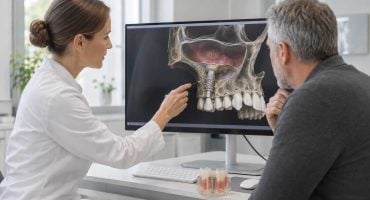
For implantologists, implantology in the posterior region is challenging. Following the loss of molars, not only does physiological resorption of the jawbone occur, but the maxillary sinus also expands. This results in a significant reduction in available bone height, making safe implantation difficult or impossible. A sinus lift specifically expands the patient’s bone volume to create stable conditions for implantation.

Read more: Upper Jaw Sinus Lift and When It Is Necessary
Dental Implants for Seniors – Suitability and Special Considerations

Dental Implants for Seniors – Suitability and Special Considerations

Many people assume that dental implants are primarily suitable for younger patients. In fact, however, more and more seniors are becoming interested in this type of dental restoration. Modern implants can help improve chewing function, speech, and quality of life. At the same time, many older adults wonder whether their age precludes them from receiving implant treatment. In principle, there is no fixed age limit for dental implants. The decisive factors are not one’s date of birth, but rather one’s overall health, oral health, and the individual conditions of the jaw. Many people receive their first implants later in life and benefit in the long term from the advantages of a fixed restoration.

Read more: Dental Implants for Seniors – Suitability and Special Considerations
Primary Stability of Implants and Its Importance for Treatment Success

Primary Stability of Implants and Its Importance for Treatment Success

Wenn ein Zahnimplantat eingesetzt wird, liegt der Fokus oft nur auf dem Endergebnis - den festen Zahnersatz. Aber der Erfolg der Behandlung beginnt schon viel früher. Ein wichtiger Punkt ist die sogenannte Primärstabilität. Sie beschreibt, wie fest das Implantat nach dem Einsetzen im Knochen verankert ist. Dieser erste Halt entsteht rein mechanisch. Das Implantat wird in den Knochen eingebracht und muss dort sofort stabil sitzen. Das ist wichtig, damit die nachfolgenden biologischen Prozesse gut ablaufen können. Wenn die Wunde nicht richtig heilt, kann das den Heilungsverlauf beeinflussen.

Read more: Primary Stability of Implants and Its Importance for Treatment Success
Dental Implants for Smokers – Risks and Chances of Success

Dental Implants for Smokers – Risks and Chances of Success

Smoking is one of the most well-known risk factors for numerous diseases and can also affect oral health. People who smoke cigarettes, cigars, or use other tobacco products have an increased risk of gum disease, inflammation, and impaired wound healing. Many smokers therefore wonder whether dental implants are even an option for them and what the chances of success are for such treatment. In general, smoking does not automatically rule out dental implants. Many smokers have successfully had dental implants for years. Nevertheless, scientific studies show that certain complications may occur more frequently than in nonsmokers.

Read more: Dental Implants for Smokers – Risks and Chances of Success
Peri-implantitis and Inflammatory Changes Around the Implant

Peri-implantitis and Inflammatory Changes Around the Implant

Dental implants are designed to remain stable in the jawbone over the long term. Nevertheless, inflammatory changes can occur in the surrounding tissue, similar to what happens with natural teeth. One of the most significant conditions in this context is peri-implantitis. This is not a sudden problem, but rather, in most cases, a gradual process. At first, the changes are barely noticeable. This is precisely what makes it difficult to detect this condition early on.

Read more: Peri-implantitis and Inflammatory Changes Around the Implant
Dental Implants and Medications – What You Need to Know Before Treatment

Dental Implants and Medications – What You Need to Know Before Treatment

When preparing for dental implant treatment, the main concern is whether existing medical conditions or medications you take daily could affect the procedure. This question plays an important role in planning dental implants, as certain medications can affect wound healing, bone metabolism, and the risk of bleeding. That’s why it’s important to consider these issues before your consultation. In many cases, treatment can still be performed without any problems. It is very important to discuss all relevant information so that it can be taken into account during the planning process. Open communication with the dental treatment team is therefore essential for preparation.

Read more: Dental Implants and Medications – What You Need to Know Before Treatment
Osseointegration and Biological Healing Processes

Osseointegration and Biological Healing Processes

After a dental implant is placed, a process known as osseointegration begins. This process is crucial for the long-term success of the implant. It refers to the direct bond between the implant and the surrounding bone. Since patients are not actively aware of this phase, many underestimate its importance. In fact, this process determines whether the implant will later be able to withstand stable loading. The surgery is always just the first step. The body does the actual work in the weeks and months that follow.

Read more: Osseointegration and Biological Healing Processes
Tooth Loss Due to an Accident – What Implant Solutions Are Available?

Tooth Loss Due to an Accident – What Implant Solutions Are Available?

Ein Unfall kann das Leben innerhalb weniger Sekunden grundlegend verändern. Neben Verletzungen an Haut, Knochen oder Gelenken, sind auch oft die Zähne betroffen. Vor allem Stürze, Sportverletzungen, Verkehrsunfälle oder Schläge gegen den Mundbereich können dazu führen, dass einzelne oder mehrere Zähne beschädigt werden oder im schlimmsten Fall vollständig ausfallen. Zunächst steht für Betroffene allerdings die akute medizinische Versorgung im Vordergrund. Danach stellt sich aber auch die Frage, wie die entstandene Zahnlücke langfristig versorgt werden kann. Moderne Zahnimplantate bieten heutzutage vielfältige Möglichkeiten, um verlorene Zähne funktionell und ästhetisch zu ersetzen. Welche Lösung hier infrage kommt, hängt allerdings von verschiedenen Faktoren ab, z.B das Ausmaß der Verletzungen, der Zustand des Kieferknochens und die Anzahl der verlorenen Zähne.
Read more: Tooth Loss Due to an Accident – What Implant Solutions Are Available?
Long-Term Stability of Implants and Relevant Influencing Factors

Long-Term Stability of Implants and Relevant Influencing Factors

Implants are a good solution when you no longer have your own teeth. However, their success does not depend on the implantation procedure itself, but rather on many factors. Long-term stability describes how well an implant remains anchored in the bone and functions without limitations. It is the result of biology, mechanics, and the body’s own processes. When planning implants, one must look far ahead, as healing, care, and the forces placed on the implant play a decisive role. During this phase, important foundations for future stability are laid.

Read more: Long-Term Stability of Implants and Relevant Influencing Factors
Immediate Implant Placement Following Tooth Loss – Benefits and Potential Limitations

Immediate Implant Placement Following Tooth Loss – Benefits and Potential Limitations

The loss of a tooth is a stressful situation for many people. In addition to aesthetic changes, it can also lead to difficulties with chewing, speaking, or performing everyday activities. Today, modern implantology procedures allow for what is known as immediate implantation in certain cases. In this procedure, the implant is placed immediately after a tooth is extracted or shortly thereafter. Many patients are interested in this method because it often allows for faster restoration and can shorten the duration of treatment. However, immediate implantation is not suitable for every situation. Whether this procedure is an option depends on various anatomical and medical factors.

Read more: Immediate Implant Placement Following Tooth Loss – Benefits and Potential Limitations
Load more

Your certified implantology network · since 2013

  • 242 Certified experts
  • 28 Countries
  • 12 Advisory board members
  • 77 Expert articles
Leading Implant Centers
Share this page on
  • Contact / Register Now
  • Become a member
  • Contact
  • Member / Partner
  • Scientific & Advisory Board
  • Partner
  • Experts
  • T&C / Imprint
  • Term and Conditions
  • Image sources
  • Imprint
  • Privacy
  • Cookie settings