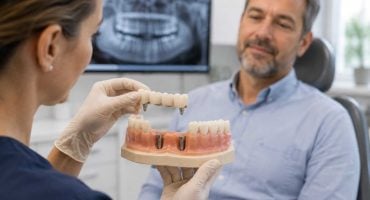
What is the difference between an implant-supported crown and an implant-supported bridge?

An implant-supported crown typically replaces a single missing tooth. The implant takes on the function of the natural tooth root, while the crown attached to it replaces the visible part of the tooth. This type of restoration is particularly suitable when only one tooth is missing and there is sufficient bone available.

An implant-supported bridge is primarily considered for larger gaps between teeth. In this case, several missing teeth are replaced by a bridge structure that is secured to two or more implants.

When is an implant crown appropriate?

If only a single tooth is missing, an implant-supported crown is particularly suitable because, unlike a traditional dental bridge, adjacent teeth do not need to be ground down. Additionally, the natural load on the jawbone is preserved, as the forces of chewing are transmitted directly into the bone via the implant. This can help counteract natural bone loss following tooth loss.

An implant-supported crown is particularly suitable:

  • a single missing tooth
  • when there is sufficient jawbone
  • when the adjacent teeth are healthy
  • when a particularly natural-looking single-tooth restoration is desired
  • This solution is often particularly effective in the front teeth area due to its high aesthetic appeal.

When is an implant bridge a good option?

If several adjacent teeth are missing, an implant bridge can offer a solution that is just as stable and, at the same time, more cost-effective.

By distributing the chewing forces across multiple implants, a durable restoration is created that is both functionally and aesthetically pleasing.

An implant bridge is particularly suitable for:

  • multiple adjacent missing teeth
  • larger gaps between teeth
  • limited bone availability
  • situations where fewer implants are to be placed

What role does the jawbone play?

One of the most important factors in the decision-making process is the condition of the jawbone. After a tooth is lost, the bone in the area of the gap gradually recedes over time. The longer the gap remains, the more pronounced this process can become.

Before implant placement, modern three-dimensional imaging is therefore used to accurately assess whether the height and width of the bone are sufficient for secure anchoring. If the available bone volume is insufficient, bone grafting may be necessary in certain cases. Only then can a decision be made as to which treatment option offers the best long-term prospects.

What are the differences in care and durability?

Both implant crowns and implant bridges require careful oral hygiene. Since implants are intended to remain in the mouth permanently, daily cleaning is particularly important. While an implant crown can be cleaned much like a natural tooth, an implant bridge requires extra attention in the area beneath the bridge structure. Special brushes or flossing aids are often used for this purpose.

Regular checkups and professional cleanings help detect inflammation early and support the long-term stability of the restoration.

What factors are considered in treatment planning?

The decision to recommend an implant crown or an implant bridge is never based on a single criterion. Rather, numerous factors are evaluated together.

These include, among others:

  • Number of missing teeth
  • Size of the gap
  • Condition of the jawbone
  • Chewing forces
  • Position of adjacent teeth
  • Overall oral health
  • Aesthetic requirements
  • Long-term treatment goals

Digital implant planning allows these aspects to be analyzed in detail even before the procedure. This results in a customized treatment plan that is optimally tailored to the patient’s individual dental situation.

Certified implantologists from our network

Every practice in our network is admitted only after meeting the quality criteria of Leading Implant Centers.

Find an implantologist near you

Our Scientific & Advisory Board developed these admission criteria and takes part in reviewing new member practices. Quality criteria · Scientific & Advisory Board

More articles